

When you find a retail space in Omaha that works for your business, it is easy to focus on the monthly rent and move quickly. The lease decides much more than that. It sets what you will actually pay, how long you are committed, what you can do in the space, and what happens if your plans change. Once it is signed, most of those terms are hard to change.
This is a general overview of the terms that tend to matter most in a retail lease. Every deal is different, and a real estate attorney should review any lease before you sign it.
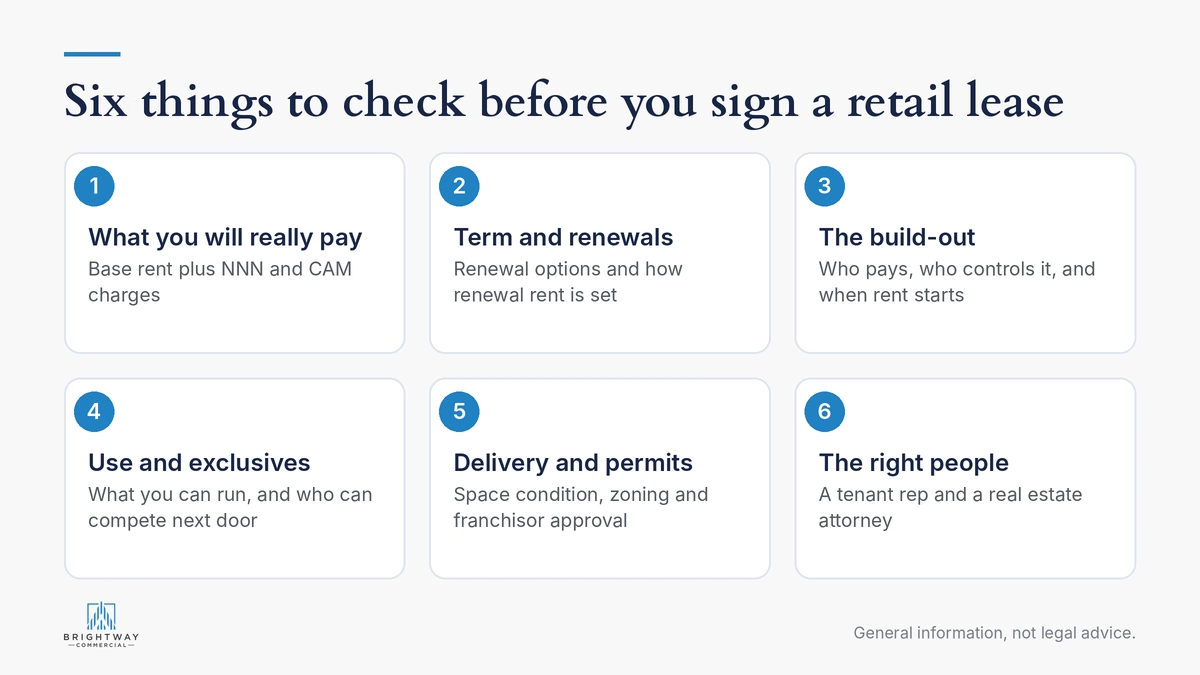
Start with what you will really pay
Base rent is only one line. Many retail leases are structured as triple net, usually written NNN. In a triple net lease, the tenant pays a share of the property’s taxes, insurance and common area maintenance (CAM) on top of base rent. Those charges are billed separately and can change from year to year.
- Ask for the estimated NNN charges per square foot and what they actually were last year.
- Ask how CAM is calculated, what is excluded, and whether an administrative fee is added on top.
- Ask whether you have the right to review the charges after the year ends.
- Check how base rent increases over the term, and whether the increases are fixed or tied to an index.
Two spaces with the same base rent can cost very different amounts once these charges are included. Compare the total occupancy cost, not just the headline rent. For more background on how leases are structured, see our guide to commercial lease types and terms.
Term, renewal options and your exit
A longer term can come with better concessions, but it also commits you for longer. Look at the initial term, whether you have options to renew, and how the rent for those renewal years is set. A renewal option with no clear rent formula can leave the number open to dispute later.
Also ask what happens if you need to leave early. Find out whether you can assign the lease or sublease the space, and what the landlord must approve. Many landlords also ask for a personal guarantee, especially from newer businesses. Understand how much it covers, for how long, and whether it can be limited or reduced over time.
Who pays for the build-out
If the space needs work before you can open, the lease should say who does it, who pays, and when. Landlords sometimes offer a tenant improvement allowance, which is a set amount toward the work. A few questions help:
- Is the allowance a true contribution from the landlord, or is it recovered through higher rent?
- Who controls the contractor and the construction schedule?
- When does your rent start compared with when the space is delivered to you?
Construction delays happen, so look for lease language that protects your opening date and your rent start date.
Use, exclusives and what is around you
The use clause defines what business you can run in the space. Make sure it fits your concept today and leaves some room to adjust. Ask whether the landlord can lease to a direct competitor in the same center, and whether you can negotiate an exclusive for your category. In multi-tenant centers, also look for co-tenancy language, which can matter if an anchor tenant leaves. Confirm your signage rights as well, including any panel on a monument sign and what the landlord and the city each have to approve.
Delivery condition, permits and timing
Confirm the condition the space will be delivered in, and who is responsible for the roof, structure, HVAC and parking lot. Before you commit, check that the zoning and permitting for your specific use are workable for that property, with the City of Omaha or the municipality where the space is located. Franchise concepts should also confirm that the franchisor has approved both the site and the key lease terms before the lease is signed.
Get the right people involved
A retail lease usually starts as the landlord’s document, so the first draft tends to favor the landlord. A tenant representative works for you, not the landlord. They can compare the space against other options, negotiate the business terms, and coordinate with your attorney on the legal terms. Our tenant representation work for retail and franchise clients covers exactly this stage.
If you are still comparing options, see our pages on retail space for lease in Omaha and Omaha commercial space for rent. To see how the negotiation itself works, read what a tenant rep does in a commercial lease negotiation.
Talk it through before you sign
If you are actively considering a space in Omaha, or you already have a lease in front of you, Nate Ohlrich, CCIM, Principal Broker at Brightway Commercial, is glad to talk through your situation. Reach out here to set up a call or a meeting.
This article is general information, not legal advice. Have a real estate attorney review any lease before you sign it.
Leave a Reply