Most retail and office leases in Omaha are written on a triple net basis, usually shortened to NNN. The base rent gets the attention, but the NNN charges that come on top of it are where landlords and tenants most often run into surprises. Misunderstandings here lead to disputed bills, strained relationships and budgets that do not hold.
This is a general overview of the NNN items that tend to get missed. Every lease is different, so the lease language itself always controls.
What NNN usually means
In a triple net lease, the tenant pays its share of the property’s real estate taxes, building insurance and common area maintenance (CAM), in addition to base rent. These are typically estimated monthly and then adjusted after the year ends. The word “net” sounds simple, but what is actually included is decided by the lease, not by the label.
What tenants tend to overlook
- The definition of CAM. Some leases list the covered items. Others use broad wording that can pull in more than a tenant expects, such as management fees, landscaping, snow removal, parking lot work and security.
- Administrative fees. A percentage may be added on top of the expenses. Check whether it applies to everything or only to certain categories.
- Capital items. Roof, structure and parking lot replacement can be treated very differently from lease to lease. Some leases keep them with the landlord, while others pass part of the cost through over time.
- Caps and exclusions. Ask whether any charges are capped from year to year, and what the landlord is not allowed to pass through.
- Reconciliation timing. Find out when the landlord must send the year end statement, how long you have to question it, and when payment is due.
- Audit rights. A tenant who cannot review the records behind the charges has little way to confirm them.
Two spaces with similar base rent can have very different total occupancy costs once these terms are considered. We cover related points in what to check before you sign a retail lease in Omaha.
What landlords tend to overlook
NNN is not only a tenant issue. Owners run into their own problems when the lease and the building’s actual operations do not line up.
- Recovery that the lease does not support. A cost that was passed through for years can be challenged if the lease wording does not clearly allow it.
- Poor records. If expenses are not tracked by category and tied to the lease, the annual reconciliation becomes harder to defend.
- Vacant space. Decide how the cost of empty suites is handled and whether the lease language supports it. Tenants notice when their share changes.
- Late or inconsistent statements. Reconciliations sent well after year end can create disputes and, in some leases, limit what can be collected.
- Communication. Tenants are far more likely to accept a large adjustment when they have been told what is driving it.
Owners considering new leases, or preparing a center for a future sale, benefit from a clear and consistent approach to these charges. Our landlord representation page describes how we work with property owners.
Questions worth asking before you sign
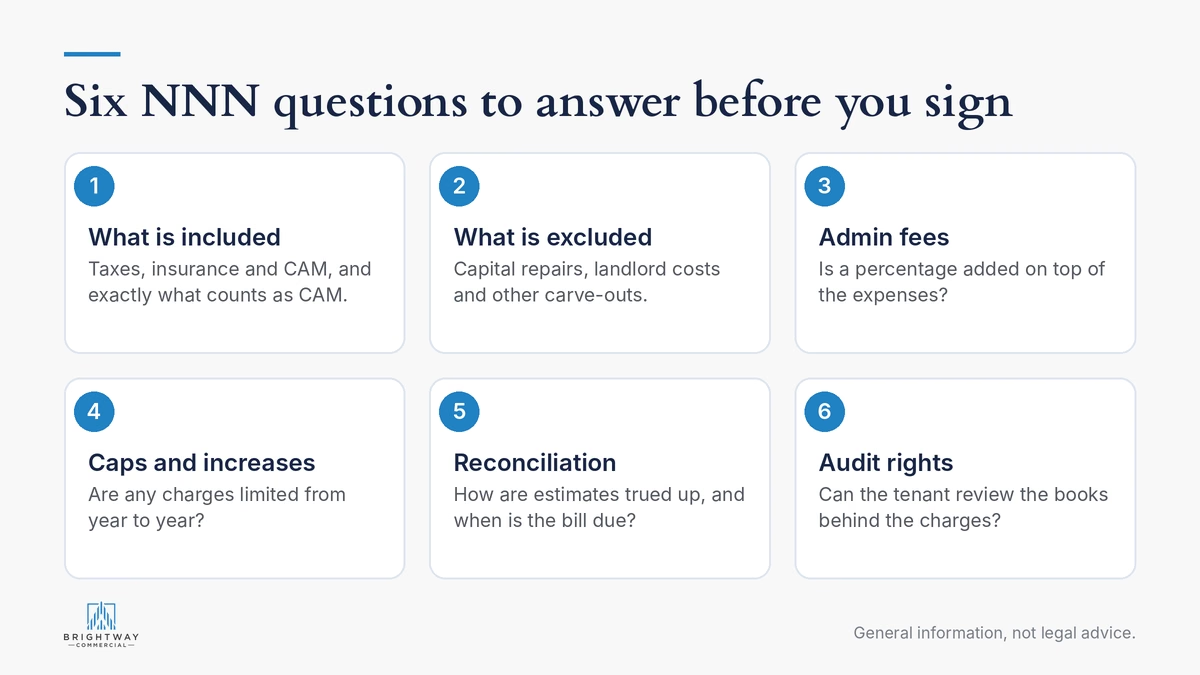
- What exactly is included in taxes, insurance and CAM, and what is excluded?
- How were the estimated charges calculated, and what were the actual charges for the last full year?
- Is there an administrative fee, and what does it apply to?
- Are there caps, and do they apply to every category?
- How and when is the year end reconciliation delivered and paid?
- Can the tenant review the supporting records?
These are business questions as much as legal ones, and they are best raised during negotiation rather than after the lease is signed. The commercial lease types and terms guide gives more background on how different structures work.
Why professional help matters here
NNN terms are rarely simple, and the details can affect your costs or your income for years. A real estate attorney should review the legal language, and an experienced broker can help you compare spaces on total cost and negotiate the business terms. Tenants can learn more about tenant representation on our site, and you can read what a tenant rep does in a commercial lease negotiation for a look at that process.
Talk it through
If you are a tenant looking at a space in Omaha, or an owner preparing to lease or sell, Nate Ohlrich, CCIM, Principal Broker at Brightway Commercial, is glad to talk through your situation. Reach out here to set up a call or a meeting.
This article is general information, not legal advice. Have a real estate attorney review any lease before you sign it.
Leave a Reply