

Opening a franchise in Omaha usually means two parties have to say yes to the same location: you and the franchisor. A site that looks great to you can still be turned down, and a site the franchisor likes can still be wrong for your budget. Knowing what each side is checking helps you avoid surprises.
This is a general overview of how that process tends to work. Every brand and every property is different, and your franchise agreement and an attorney should guide the final decisions.
What the franchisor is looking for
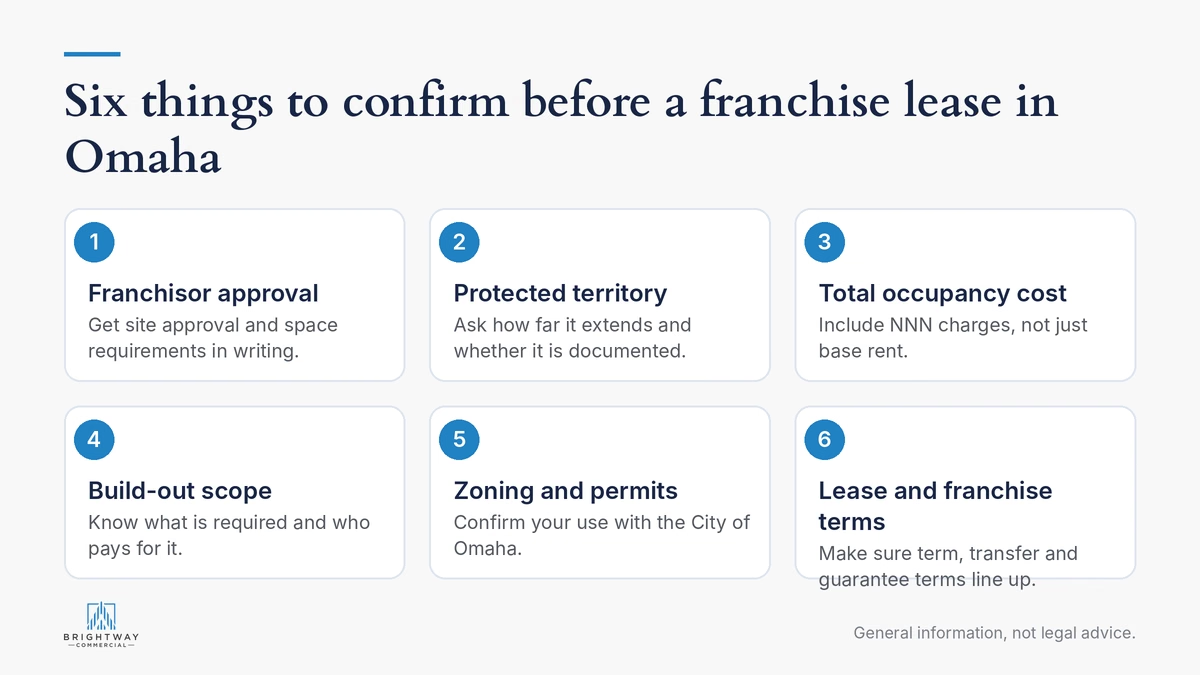
Most franchisors protect their brand by controlling where new units open. Their approval process often looks at the size and layout of the space, visibility and signage, parking, traffic patterns, nearby co-tenants, and the demographics of the surrounding area. Many also define a protected territory, so ask how far it extends and whether it is in writing.
Expect the franchisor to have its own requirements for the space, such as ceiling height, frontage, utilities, or drive-thru capability. Ask for those requirements in writing before you tour anything, so you are not touring spaces that cannot qualify.
What the franchisee needs to confirm
The franchisor’s approval does not mean the site works for your business. You are the one signing the lease and carrying the costs, so your own review matters. A few things worth confirming:
- Your all-in occupancy cost, including the triple net (NNN) charges for taxes, insurance and common area maintenance that are billed on top of base rent.
- Whether the build-out the franchisor requires fits your budget, and who pays for it.
- The lease term compared with your franchise agreement term, and what happens if the two do not line up.
- Whether the landlord will allow your use, signage and any exclusive you need for your category.
- What the lease says about assignment, transfer and personal guarantees if you ever sell the franchise.
For more on the lease terms behind these questions, see our overview of what to check before you sign a retail lease in Omaha.
Zoning, permits and the City of Omaha
A space can be available and still not be permitted for your use. Some uses, such as restaurants, drive-thrus, fitness, or child care, can face zoning or permitting questions that depend on the specific property. Check with the City of Omaha or the municipality where the property sits before you commit, and make the lease contingent on those approvals where you can.
Timing between approval and lease
Franchise deals have many moving parts: franchisor site approval, financing, permits, and the lease itself. Each takes time, and a delay in one can hold up the others. Landlords may not wait while you work through approvals, and your franchise opening date may be fixed. It helps to plan the order of these steps early and to build time for them into the lease.
Why the process is harder than it looks
Choosing a franchise site is not a quick search. It involves market data, a franchisor with its own review process, a landlord whose lease is written in the landlord’s favor, and deadlines that affect each other. Mistakes here are expensive and slow to undo, which is why many franchisees bring in a tenant representative who works only for them. Our tenant representation work covers market analysis, site tours and coordination with the franchisor. You can also read what a tenant rep does in a lease negotiation to see how that role works once you have a site in mind.
Talk it through before you commit to a site
If you are planning a franchise location in Omaha, or you already have a site under consideration, Nate Ohlrich, CCIM, Principal Broker at Brightway Commercial, is glad to talk through where you are in the process. Reach out here to set up a call or a meeting.
This article is general information, not legal advice. Have a real estate attorney review your franchise agreement and any lease before you sign.
Leave a Reply